

 Follow
In autumn 2000 the Migratory Raptor Conservation Project began standardized, full-season counts at a single watch site in the Kèköldi Indigenous Reserve in southern Caribbean-slope of Costa Rica. Kèköldi, is one of the very few of places in the world – together with Veracruz, Mexico, and Eilat, in Israel – where it is possible to observe many thousands of raptors migrating in one season.
Most migrant raptors migrants that pass through Costa Rica come from North America. All 33 species of raptors that occur in the United States are migratory and all but six regularly migrate into Latin America and the Caribbean.
Seven species observed in October 2011 show numbers that make a good example of how numerous the migration can be in five days:
Broad-winged Hawk 22737
Swainson´s Hawk 12977
Turkey Vulture 18475
PeregrineFalcon9
Osprey15
This year not only the indigenous people and ornithologist in Kekoldi, but all birders in the country are very excited about the new visitors. But not only raptors take this long journey to the warm tropical weather. A very wide range of all sorts of birds from many different familias are found in Costa Rica from late October to May.
No wonder why so many birders from all over come to Costa Rica in birdwatching trips and tours to see their migrants wintering here.

They started coming. Ornithologist from UOCR (Union of Ornithologists of Costa Rica), birdwatching the common sites where migrants are reported, have organized tours to find them. They have reported some early birds in diverse habitats in the country. Recently , Daniel Martinez reported some shore birds in the Southern Pacific.
Here the numbers:
Whimbrel 9
Sanderling 1
Rudy Turnstone 15
Willet 15
Semipalmated Plover 2
According to literature, those species are expected to arrive in August. So, some experts are thinking that maybe some of then didn’t migrate back but decided to stay. However, Turnstones and Sanderlings had breeding plumaje, what probably means they just arrived.
After some birding trips on the Northern Caribbean, some new species appear.
Black-bellied Plover 9
Semipalmated Plover 15 (breeding plumage)
Spotted Sandpiper 5 (breeding plumage)
Willet 1
Rudy Turnstone 18
Sanderling 23

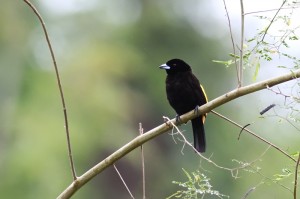
I have been wondering what new report would bring us the bird 901. And also whos going to be the lucky one to see it. Well, the tour guide Luis Miguel Cruz saw a Flame-rumped Tanager (Ramphocelus flammigerus) on February 1, 2012 at Tortuguero National Park. This park always bring surprises to the ones who visit the area for birdwatching tours. The species was recorded at the mouth of the Rio Parismina, an open grassland habitat and isolated bushes.
I have seen the bird many times birdwatching Panama, in Valle de Anton area. The first impression is that you have a red rumped Tanager (Passerini´s or Cherrie´s), but once it turns and show you its bright yellow back you immediately know that you got something different. This new sighting is included in the sixth official list of Birds of Costa Rica.
The males are black, light blue-gray bill with black tip, lower back with yellow feathers. The female is brownish and yellow ventrally. The previously known distribution range is from western Panama to western Ecuador.
We may think that such an obvious color is unmistakeable, bur the inclusion of this new species to the UOCR (Unión de Ornitólogos de Costa Rica) increased tensions between UOCR and AOCR (Asociación de Ornitólogos de Costa Rica). The last is not accepting this new report as a new species because they say UOCR took the decision too quickly. Controversy brings interesting info about bird coloration. Here is some of the comments posted in UOCR´s blog (www.uniondeornitologos.com ):
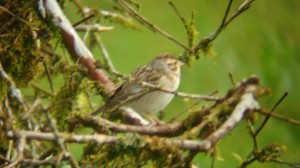
At first sight is a bird that looks like Rufous-colllared Sparrow. But you better be carefull. One individual of Clay-colored Sparrow (Spizella pallida) was reported and photographed by Steven Aguilar in Turrialba during the 13th, 14th and 15th of January. Recent reports around CATIE indicate that the birds still in the area. The presence of this Spizella sets the official list of Costa Rica in 902 species.
Checking the picture they send to UOCR (attached), note the broad buffy whitish list. Buffy cheeks bordered by two dark brown stripes, this allows us to differentiate Spizella Passerina. It is also very evident the neck and sides of neck gray. . They have a pale crown stripe on a dark brown crown, a white line over the eyes, a dark line through the eyes and brown wings with wing bars.
The birds migrates from North America and is also found in Mexico, Guatemala, Cuba and other West Indies. In Belize is considered vagrant, and eBird reports it in Cayman Islands.
Reading UOCR´, blog, Luis Sandoval says: My guess is that this birds is part of the population in Mexico.
Now you know. Next time you are birdwatching Turrialba area better open your eyes!!
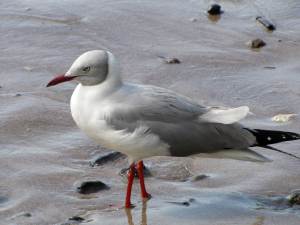
Tortuguero always bring surprises. This time, Kelp Gull (Larus dominicanus) was seen and photographed by Sebastian Bonilla when he was birdwatching the Colorado River mouth, Parque Nacional Tortuguero. The bird is also known as the Dominican Gull (the specific name comes from the Dominican Order of friars, who wore black and white habits). It breeds on coasts and islands through much of the southern hemisphere. So, this time the new arrival to the list comes from the south. Sub species of L. dominicanus are found around South America, parts of Australia, New Zealand and around southern Africa (OUCR´s forum).
Gulls are not easy to tell apart. That’s why Luis Sandoval asked three birders from North America with extensive experience in identifying gulls (Steve Pike, Kevin McLaughlin, and Alan Wormington). They agree on the identification of the species.
But here is the controversial point again. Juan Diego Vargas sent the attached pic to people with experience in ID gulls in North America (among them Paul Lehman).. Their opinion is that although it may be L. dominicanus there is no way to exclude Great Black-backed Gull (L. marinus).

Vermilion Flycatcher is reported in Nicaragua and also in Panama. As an accidental bird yes, but that means it has reached the southern part of Central America in the past. That is true, but not for Costa Rica. It has never been reported in our country. It is because it flew over Costa Rica at night and nobody sow it? Or maybe visited our country but stayed in remote areas where birdwatchers never go? Well, the fact is that the bird was photographed in August 7th , 2011 by Jorge Corrales without knowing he got a new species!! Because of that the bird remainded undiscovered until now.
Jorge was birdwatching in an area of the province of Guanacaste called Santa Cecilia. He saw a bird standing in a barbed wire fence and took a picture just before it took off. When he returned back home totally forgot about the pic, and it was just a couple of weeks ago when he rediscovered the bird.

2012 was an extraordinary year for new species of birds, most of which were ducks. Birdwatchers inCosta Ricareported new sightings in various national parks, and bodies of water in Guanacaste andNorthern Caribbeanarea. Several of the ducks had never visitedCosta Ricain the past. Well, as far as the birders knew. But, the fact is that we have more eyes looking for something new or unusual than many other countries around the world because of the large number of local guides, amateur birders, serious ornithologists, and tourists travelingCosta Ricain an organized birding trip.
Few of these bird species came back in 2013, but this year has been the opportunity for seagulls.
In Cocos Island, part of our territory but closer to Galapagos, the park ranger Esteban Herrera saw and photographed an adult Gray-hooded Gull (Chroicocephalus cirrocephalus) on February 2 and 3 2011. It’s an old report that had not been previously received.
Another gull was reported in the Pacific area. At the mouth of the Rio Tarcoles, California Gull (Larus californicus) was observed by Daniel López Velasco on March 2, 2013.
This puts the list at 906 species. What will be the total number when we finished in 2013?
Well, after little more than five months we got a new bird! This time is a flycatcher, migrant from North America, no wonder!!
Esteban Herrera and Guillermo Blanco, both members of the National Park System and local rangers photographed and registered an individual of Eastern Phoebe (Sayornis Phoebe) 2003 at Wafer Bay, in Coco´s Island in a period of time that goes from March 27 to 30th, 2013.
Again, the new addition is a flycatcher who comes by the very first time from North America. Is well known for wintering farther north than most other flycatchers, but this time decided to go down south as far as Costa Rica.

A sub species that lives only in Galapagos decided to visit us and hit the records!
We have not finished celebrating our species 907 and we have a new one. White-cheeked Pintail was photographed in WaferBay,Cocos Island on August 28, 2010 by Esteban Herrera, ranger of Cocos National Park. The subspecies Anas bahamensis galapagensis is restricted to the Galapagos Islands and nowhere else, so this register is of great importance. The subspecies was confirmed by the Scientific Committee of Asociacion Ornitologica de Costa Rica and authorities of the Charles Darwin Foundation in the Galapagos Islands,Ecuador.

A group of birders reported an individual of Maguari Stork on September 16, 2013 in Chomes, Puntarenas. The lucky ones were leaded by James Zook, a member of AOCR Scientific Committee. Days after the sighting several others run to the same place looking for the bird with no success.

Popular posts from our blog!
