

Long live the king!
 Follow
Natural History of the most beautifuf vulture of the world
(or the ugliest of ibises)

The King vulture is without any doubt one of the “big five” birds that all birders and photographers who visit the Tropical Americas want to see. This large bird found in Centraland South America, lives predominantly in tropical lowland forests from southern Mexico to northern Argentina.
According to the red list status of the IUCN- International Union for Conservation of Nature, the status of this bird is Least Concern but they also say that current population trend is Decreasing.
Vultures here and in China are ugly, we all know that, but this species is a real exception and there is no obvious adaptive biological reason for this unusual coloration. If you work for the sanitation deparment of the forest you have to be efficient but not beautiful, isnt it?

Our King Vultures are among the bird world’s largest scavengers, but they also kill small reptiles, wounded animals, newborn calves and there are reports of king feeding on palm fruits.
They have powerful, hooked beaks that are pretty well adapted for tearing open tough carcasses. Thats exactly what the Old vultures do as well. Neotropical and Paleotropical vulture’s head and neck are bald. There is a reason for that. This may help the birds to stay clean, and ensure that the decomposed organic remains don’t not cause infections or bacterias reproduce in the bird’s plumage. All vultures have the same problems and nature invented the same solutions. This is another kindergarden explanation of the concept of evolutionary pressure and adaptation. Again, all the vultures in our universe look the same because they do the same, but Old World vultures and New World vultures are not related. Not even close.
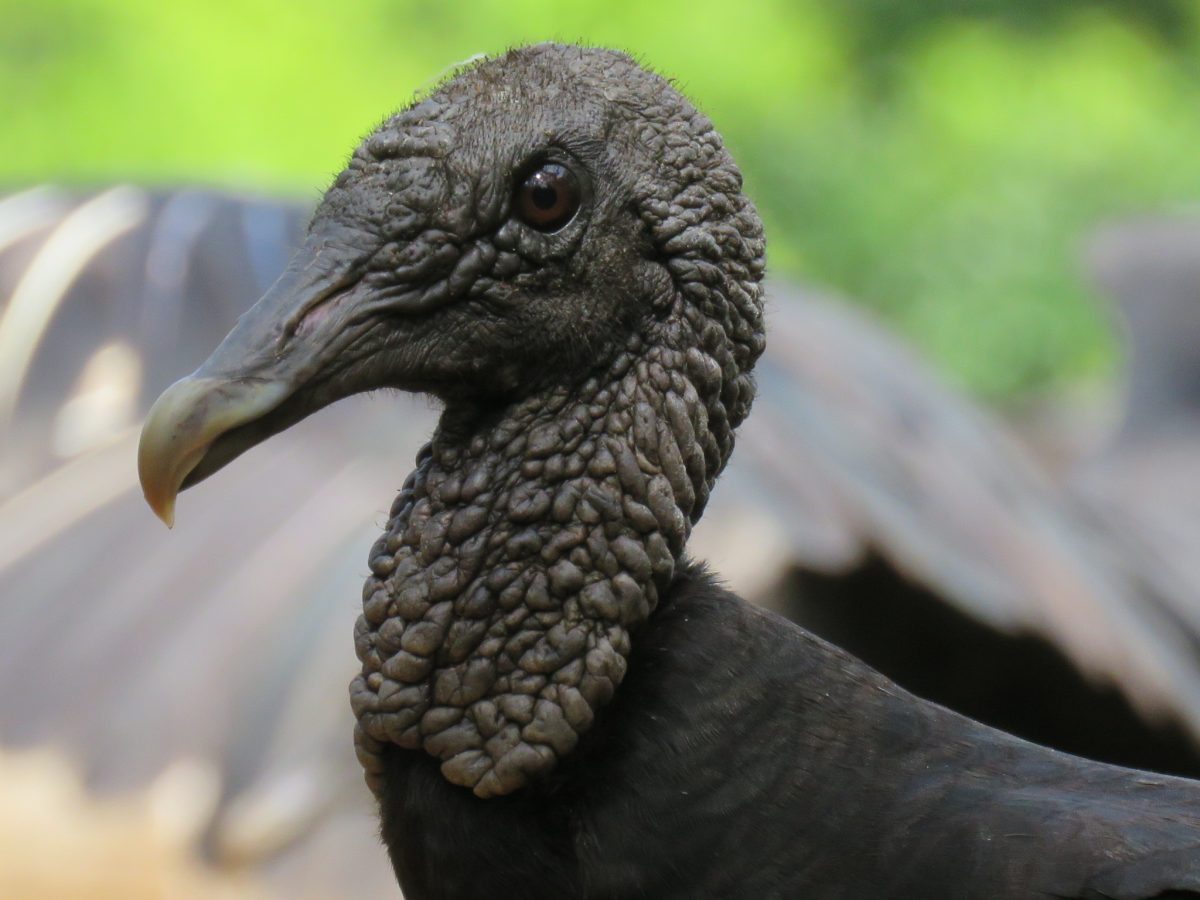
The New World and Old World vultures evolved from different ancestors in different parts of the world. Vultures from Eurasia and Africa belong to the accipiters and are related to raptors (eagles and hawks). Our vultures in the Tropical America belong to the cathartids and are related to the ibises. Yes ibises, believe it or not.
Well, I am sure that the eagles of Europe are not very proud of their vulture cousins, but what would the Roseate Spoonbill would say about their vulture relatives ?
But the King Vulture is an exception.

The scientific name is Sarcoramphus papa and it is the only surviving member of this genus. The genus comes from the Greek word sarx, “flesh”, and rhamphos, “crooked beak of bird of prey”. What happens is that the bird has a very noticeable orange fleshy caruncle on its beak. The species name comes from the Latin papa, “bishop”, probably because the bird’s plumage resembles the clothing of one. In Spanish the word for the Pope is Papa. A coincidence?
So the English name derived from Greek and Latin of the bird should be “The bird of prey with a crooked and fleshy beak that looks like the Pope”.

King Vulture is not the only neotropical vulture, there are six more species: Andean Condor (king vulture’s closest living relative), California Condor, Black Vulture, Turkey Vulture, and Lesser and Greater Yellow- headed Vulture. There is fossil evidence of another member of Sarcoramphus living in North America. Bones of the Kern vulture (Sarcoramphus kernense) were found at Pozo Creek in Kern County, California.
How about Florida? Well, let me tell you a really interesting story. Please look at the following painting. It was made in 1734 by Eleazar Albin. This drawing has been called the “Painted Vulture”
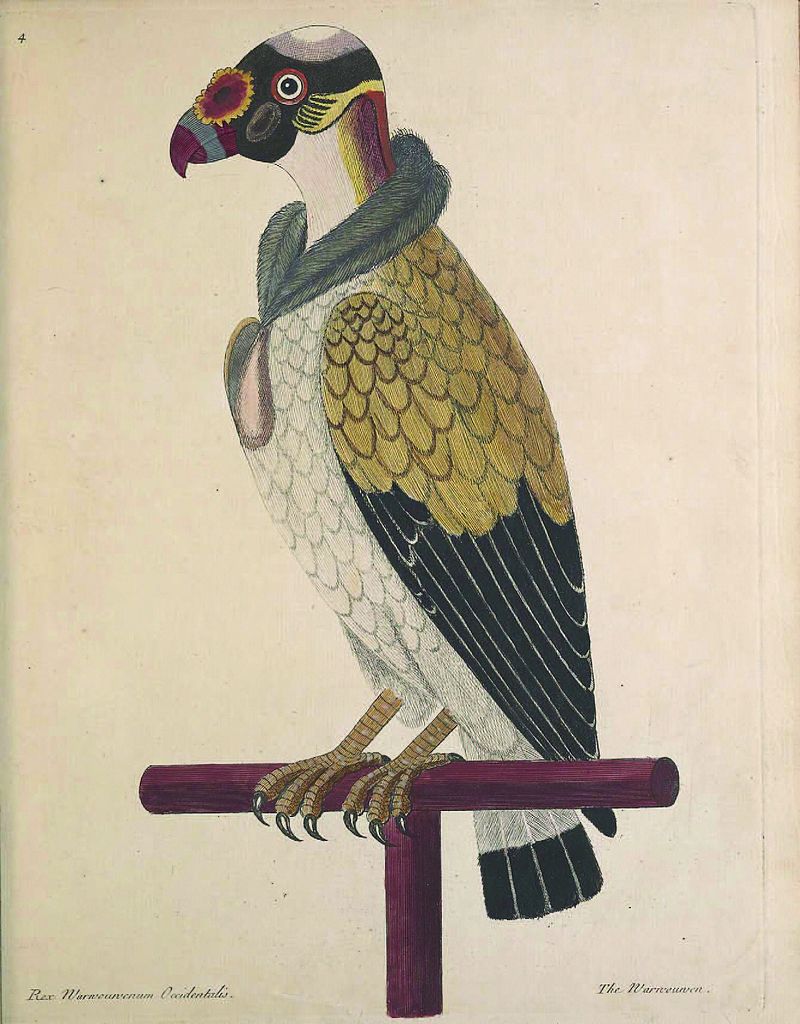
This bird is a King Vulture I am sure. What else could it be?
Mr William Bartram was an american explorer who spend a good part of his life studying the botany and ornithology of the southern British colonies in North America. People consider him as the first naturalist who penetrated the dense tropical forests of Florida.
He described in 1791 two species of vulture new to science. One is the Black Vulture, common from the US to Chile. The second one matches the description of the King Vulture
almost completely except for the tail. Mr Bartrams called the bird Vultur sacra, and one of the most relevant parts of the description is its white tail, and the King Vulture we know has a black tail. He also used other names for the bird like White Eagle, White- tailed Vulture or Croped Vulture.

Some ornithologists from 19th century considered the vulture as a distinct species or a subspecies of the one that lives in Central and South America Mr Bartram called it Painted Vulture and described the bird as being abundant and even claimed to have collected one.
To make the story even more interesting, fifty seven years before of Mr Bartram´s report a drawing of Painted Vulture was made by the naturalist Eleazar Albin in 1734, but no one knows where this “report” comes from. No other naturalists recorded the Painted Vulture in Florida and sixty years after the sighting its validity began to be questioned. In the late 1800 the first president of AOU – American Ornithologist´s Union Mr Joel Allen call it a “purely mythical species”. Currently the bird is omitted from official checklists. However, recent ornithologist think the Painted Vulture went extint by the early 1800s and should be recognized as vanished but valid North American species (Sarcoramphus sacra or S. papa sacra).

I find this an exciting mystery. No wonder why the prominent american ornithologist Mr John Cassin described this as the most inviting problem in North American ornithology. There is an excellent description of the situation in an article written by Noel F.R. Snyder and Joel T. Fry named “Bartram´s Painted Vulture: A bird deserving recognition”. In Cassinia, DVOC.org 2016/ 06
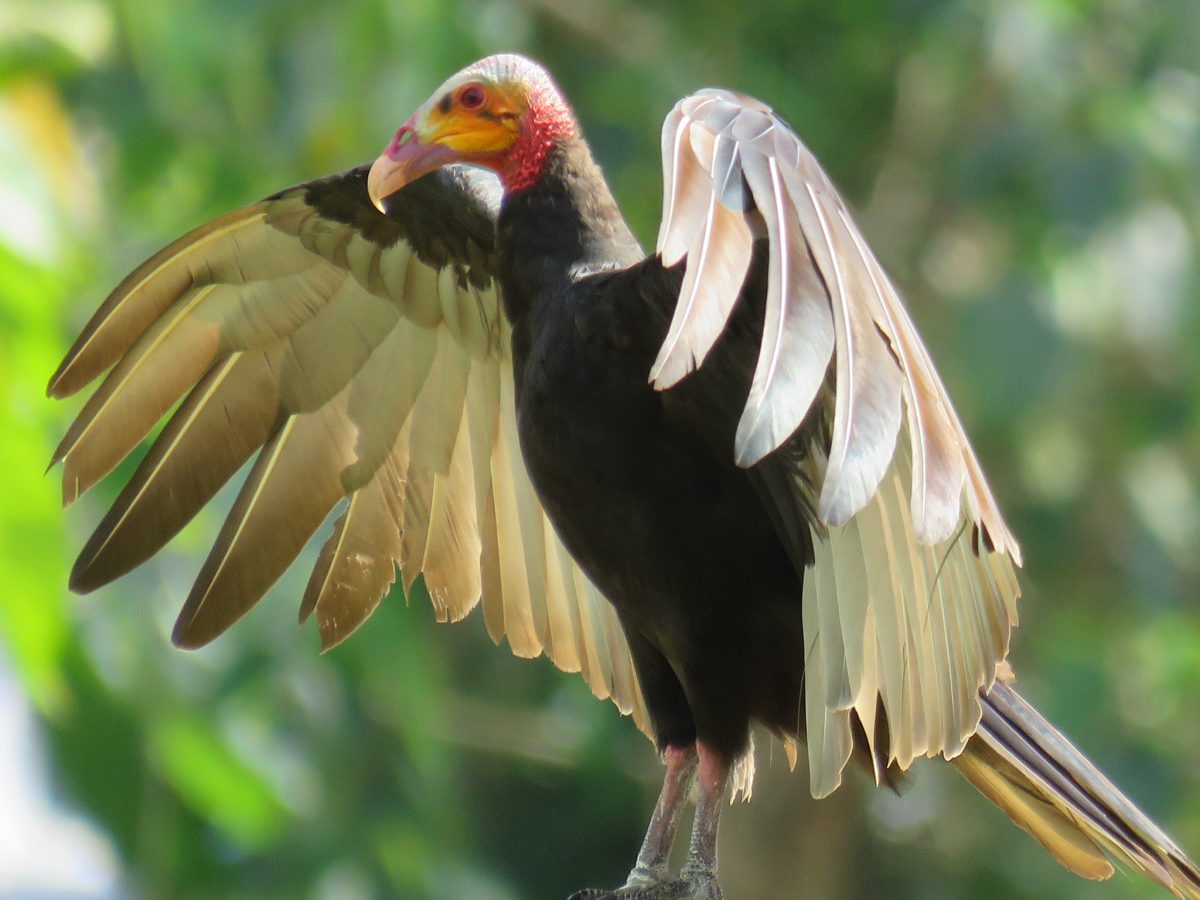
The species shows a little sexual dimorphism, with almost no difference in plumage and little in size between males and females.
At this point readers from Asia, Europe and Africa have it clear that your vultures are not related to ours. But, what group has the largest species? Well, this is a topic that intrigued me too and here are some measurements between Old World and New World vultures as a comparison:
King Vulture total length 71-81 cm wingspan: 170-200 cm
Bearded vulture total length 94–125 cm wingspan 231–283 cm (Lammergeier)
Cinereous Vulture total length 100–120 cm wingspan 250–295 cm
Andean Condor total length 100–130 cm wingspan 260 –320 cm
According to the information I have found, Andean Condor is the largest of all vultures.
King Vulture is a scavenger. Like other vultures, they glide on air currents, conserving energy while searching the forests or savanna below for the corpses of dead animals. Consensus has been that it does not detect odours, and Scientists of Cornell University say that these vultures lack a developed sense of smell and they depend on other vultures to lead it to a carcass. However a 1991 study demonstrated that the king vulture could find carrion in the forest without the aid of other vultures, suggesting that it locates food using an olfactory sense.
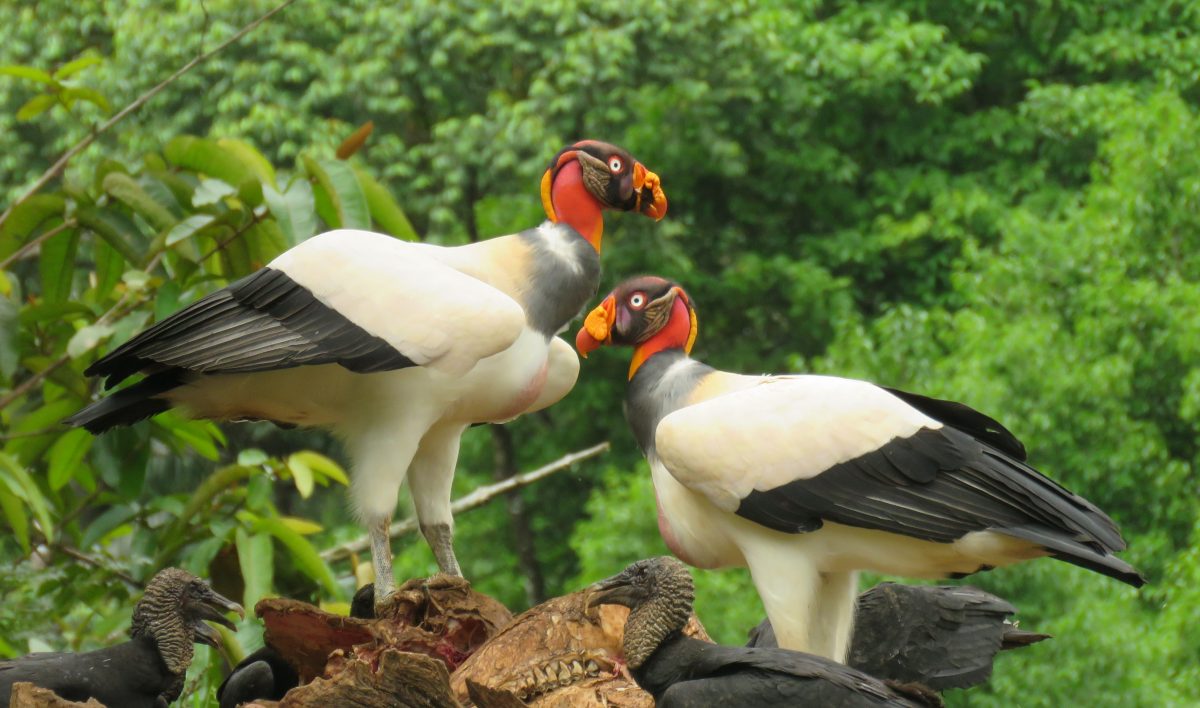
This vulture is called King because of its majestic appearance, but also the local people in Latin America say that the King Vulture displaces smaller New vulture species and makes the initial cut into a fresh carcass because of its higher hierarchy. The truth is that due to its stronger beak it can break the skin of large animals like cows and horses more easily. For this reason the other vultures let him eat first and thus leave the table served for the others.
King Vulture is a non- migratory bird and, unlike the turkey, lesser- yellow headed and black. It generally lives alone or in small family groups
Note: This is a series of articles about birds of the Neotropics. The species of birds that will be covered in this collection of articles are toucans, quetzal, motmots, manakins, tanagers, and many other species.
The articles do not have a scientific format, but rather have a general informative character. The text is the product of the investigation of works written on the subject, although bibliographic citations are not provided.
Wildbird is a tour operator agency that organizes birdwatching trips to Costa Rica and Panama. Tours for photography and birding holidays.


