

What kind of Hornbill is a Toucan?
 Follow
You briefly saw a bird but you are not sure if it is a Tucan or a Hornbill. So how do you tell them apart at a glance? First clue, look around you. Where are you? Africa, Asia? Ok, is a hornbill.
Anywhere from Southern Mexico, through Central America to northern Argentina? Well, is a toucan!
Both families of birds look very similar, but they are not related. They belong to different orders, and that represents an important distance in phylogenetic terms. They look the same because they do the same. This is the kindergarden´s explanation of convergent evolution. Both groups play the same role in the forest but they live in totally different parts of the planet. Both have the same environmental pressures and for that reason they developed the same morphological solution. This has happened in many animal groups. The case of the vultures of the old world and the vultures of the neotropics is similar, but I will talk about that in another blog.

Both families have characteristic bills adapted for reaching fruits and probing into tree cavities, however most hornbills have a distinctive beak feature called a casque and toucans dont have it. Researchers say this feature gives hornbills the ability to amplify their vocalizations in the rain forest.
Although not only the beak is a common trait. Wide, short heavy wings adapted for flight under the forest canopy, makes both groups a sort of clumsy flyers that prefers hopping from branch to branch. Birders in the Paleotropics and birders from the Neoptropics are used to see those birds gliding for short distances in the middle of the forest.
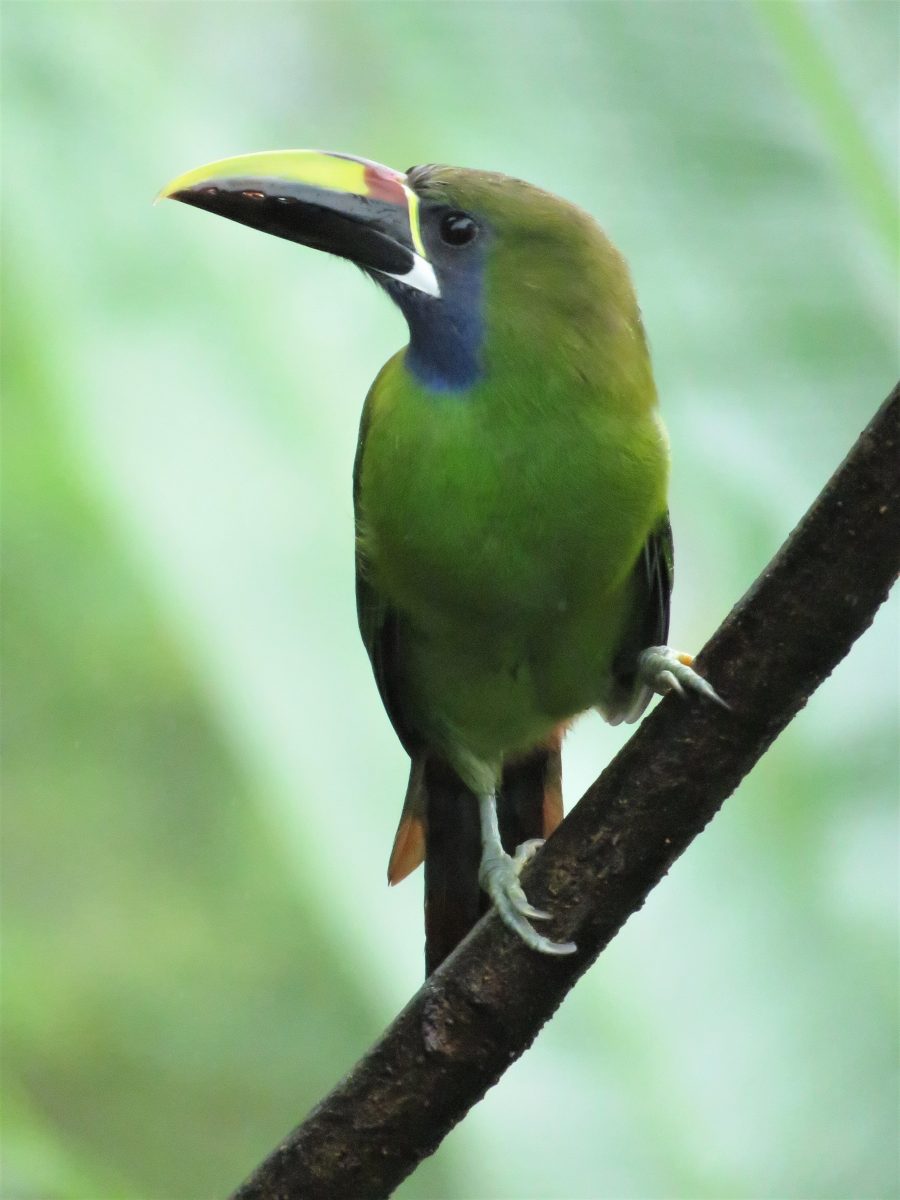
Tucans and hornbills have a long tail, predominantly black and white plumage in general with contrasting brightly colored beaks and rumps, are some characteristics that also have in common. Their behavior and natural history have many similar aspects. Both hornbills and toucans nest in tree cavities. They are both omnivorous feeding on fruits (tucans are primarily frugivorous), insects and small creatures, including smaller birds, bird eggs, lizards and young mice. I have personally observed tucans feeding on snakes, quetzal chicks and bats.
No matter how many characteristics they have in common, what really stands out in these birds is the size of their beaks. It is for that reason that I am going to dedicate a little more explanation to this outstanding and unmistakable trait in both groups.

Their similar bills come in handy when foraging for food, to make their nests, and protecting eggs and nestlings from potential predators. Bird beaks are made of keratin, a fibrous protein in hair and nails on humans, scales on reptiles and feathers on birds. When we see these long and prominent bills, we have the impression that they are heavy and that their bite is strong and painful. Well, according to what I have heard, ground hornbills don’t bite hard enough to hurt. But I have also read that the crushing strength of the hornbill beak is six times greater than that of the toucan. In the case of tucans, I personally made the experiment once. Not long ago, I had the opportunity to take in my hands an Keel- billed Toucan that got caught in a mist net. I told myself it is now or never, and I presented him with one of my fingers in sacrifice of science. To my surprise the bite was quite soft.
The toucan’s beak might look heavy, but some studies shows that the beak is optimized to an amazing degree for high strength and very little weight. Though large, the bill of the toucan is mostly hollow and light. I took the following picture of a Toco´s Tucan bill at the Natural History Museum in London. You can clearly see the inside structure that looks like fiberglass.

Interestingly, the toucan has a long tongue to match its large beak, whereas the hornbill’s tongue is pretty short. Also, the tongue of a toucan is long and narrow and lined with bristles that help them swallow food.
At this point I hope it is clear that toucans and hornbills look alike but they are not family, not even cousins. So who are the relatives of toucans? Neotropical barbets and woodpeckers are related to them. They all belong to the order Piciformes, whose members possess two rearward- and two forward-pointing toes. This this feature is called zygodactil feet (or feet with toes facing in different directions) – two toes face forward and two face back. Toucans are members of the family Ramphastidae with 35 species.

The name Toucan comes from the word tukana given by the Tupi aboriginal group from Brazil. They are resident breeders and do not migrate. In the forest they usually found in pairs or small flocks. Some of the big species like Keel- billed and Yellow- throated Toucans sing from a high perch in the afternoon. They are in general are among the noisiest of forest birds. They can live for a period of up to 20 years.
Along with hummingbirds, motmots, and manakins, toucans is one of the neotropical families that you shouldn´t miss.
Note: This is a series of articles about birds of the Neotropics. The species of birds that will be covered in this collection of articles are toucans, quetzal, motmots, manakins, tanagers, and many other species.
The articles do not have a scientific format, but rather have a general informative character. The text is the product of the investigation of works written on the subject, although bibliographic citations are not provided.
Wildbird is a tour operator agency that organizes birdwatching trips to Costa Rica and Panama. Tours for photography and birding holidays.


